



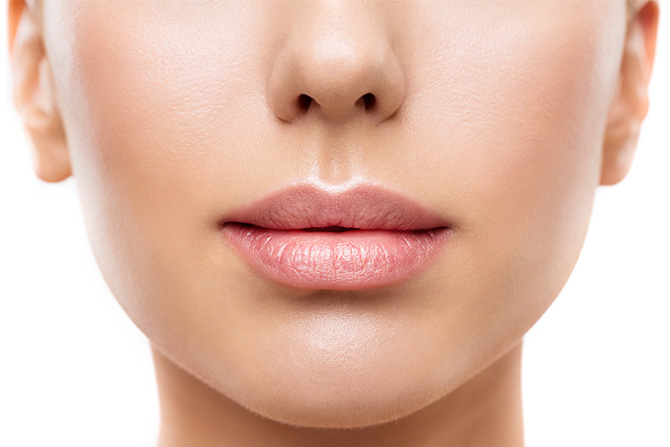

The position of the mouth is arguably the single greatest source of complaints regarding the appearance of the deceased. “The lips don’t look right.” “The mouth is too wide.” “He looks angry.” “My dad never wore lipstick.” All of these comments are familiar to us. Let’s break down the causes of some of these problems.
The Lips Don’t Look Right
Without a photograph, it is difficult to know how someone’s mouth appeared during life. Generally, problems arise because of the amount of upper and lower mucus membrane (the reddish portion of the lip) which we determine should show. Especially when there has been a loss of weight and a corresponding loss of muscle tissue, the lips may flatten and lose their natural curvature. The absence of teeth or dentures also makes it necessary for the embalmer to “guesstimate” the best position for the lips. By making sure that we have restored the underlying foundation when positioning the mouth — whether we do that by using a mouth former, cotton treated with Kalip or Inr-Seel — we can simplify the determination of the line of closure, and thus the amount of upper and lower mucus membrane which is visible.
The Mouth Is Too Wide
Of all the comments about mouths from family members, this one is probably the most commonly heard by funeral directors. If the mouth of the deceased appears too wide, the cause will probably be found amongst the issues listed in the previous paragraph. To fully understand the changes in facial features which are produced by aging and sickness, we need to look at the foundation of the facial features.
The shape of a person’s face is determined by layers of skin, subcutaneous fat, muscle and bone tissue. A change in any of these components will ultimately change the appearance of someone’s face. No matter whether it is the result of age, trauma or disease, the slightest change will be noticeable to those viewing the deceased. Most often when the appearance of the mouth is unnatural, there are other corresponding anomalies in the face which may not be commented upon. This is because people viewing a remains normally focus on the mouth and eyes rather than other features.
When the mouth of the deceased seems too wide, it’s likely that the cheeks lack fullness, the chin is not as wide or pronounced as it should be and the jaw line is sharper or more clearly defined than it was in life. These changes are caused by the loss of tissue mass in the face. We know that when muscle tissue atrophies, it shrinks or diminishes in size. Especially when the muscles are arranged in a circular manner and capable of contracting as they are around the eyes and the mouth and to some extent the nares, if this tissue atrophies or becomes desiccated, it will distort the normal shape of the feature.
Simple gravity and the shrinkage of the tissues supporting the mouth will cause it to flatten and will cause the corners to pull outward and downward. When the embalmer positions the mouth, unless he or she compensates for this loss of foundation, there will be a tendency to have a very flat mouth which doesn’t exhibit a normal size or curvature. Keep in mind that the anatomical outer limits for the mouth are the centers of the eyes. Remember too that the thicknesses of the upper and lower integumentary lip have probably diminished when the subject is of advanced age or has died of disease. Knowing these two things, the embalmer can compensate for loss of underlying muscle and fat and can create a natural looking mouth.
Can You Put a Smile on Their Face?
I think when funeral directors hear this request, we sometimes cringe. However, what most families usually mean is that they would like their loved one to have a pleasant expression on their face. The appearance of the mouth is the primary determining factor in creating a pleasant expression.
If the mouth is turned down at the corners and for some reason the angulus oris eminences are not visible, this will leave the mouth with an appearance of a neutral or even negative expression. To understand this, examine your own face in the mirror. Begin by totally relaxing your face. See the position of the corners of your mouth and observe the flatness just above the corners. Now think of something pleasant and allow yourself to smile just slightly. As you look in the mirror, notice how the corners of your mouth begin to turn up and the eminences above them become more evident. This slight change in the position of the corners of the mouth and the angulus oris eminences makes a tremendous difference in the appearance of the deceased, just as it made a tremendous difference in your own face as you watched it in the mirror.
For the embalmer to be able to establish this expression on the mouth, there must be sufficient foundation for the upper and lower integumentary lip. It’s quite advantageous to use a material such as Inr-Seel for any filling which must be done, since this mastic material is able to be molded with greater success than cotton, and Inr-Seel will maintain the position you leave the features in. When the foundation has been put into place, then the mucus membrane portion of the lips should be placed into proper position. When the positioning of the mouth is completed, the corners should be positioned as has just been explained.
If the mouth does not want to stay in that position, you may need to remove some Inr-Seel or add more of it. The embalmer will find there is no substitute for practice in achieving success with this. The establishment of the angulus oris eminences can be achieved by using the blunt end of an aneurysm hook. The eminence is slightly elevated in comparison to the upper integumentary lip, with a border curving in toward the mouth.
The Mouth Looks Too Full
There can be several reasons why the mouth of the deceased can look full or, on some individuals, pursed. If the mouth has been overfilled with cotton or Inr-Seel, or if the mouth former has not been properly fitted, these things can cause the lips to protrude unnaturally. Another explanation may be that the mouth has been closed too tightly. Especially if the deceased does not have their own teeth and dentures are unavailable, it is common to close the mouth without leaving the proper spacing between the mandible and the maxilla.
When the mouth is closed too tightly, the integumentary lip will push out, producing a full or pursed expression. The embalmer must rely on his or her own judgment to determine the amount of space between the upper and lower jaw so as to produce a natural looking mouth closure. When someone has their own teeth or dentures, you should position the jaws so that there is a 1/8” to 1/4” gap between the upper and lower rows of teeth. When teeth or dentures are missing, the embalmer must add this distance to the estimated space the teeth or dentures would have taken up when determining how to position the jaws.
One sure sign that the mouth has been closed too tightly is unnatural looking skin folds. These will usually occur in two places. One is directly beneath the root of the nose, in the philtrum. This fold will be horizontal and will disappear when the tension on the injector needle has been relieved slightly. The other folds which can be seen when the mouth is closed too tightly are at the corners of the mouth. If you have creases here which disappear when the injector needles are loosened slightly, the mouth was probably closed too tightly.
Since it is more closely examined than any other feature on the deceased, extra attention to foundation building and positioning of the mouth is essential to ensure the satisfaction of the family. The appearance of the mouth will also determine the first impression of all the other individuals viewing the deceased — and therefore their first impression of you as a professional.
One of the most frequent questions we get asked is regarding lip cosmetizing. I’ve been asked countless times whether we manufacture “a good lip color.” Well, as the saying goes, “There’s good news, and there’s bad news.” The good news is that Dodge manufactures several blended cosmetics which will provide a natural cosmetic treatment for lips. The bad news is that we don’t manufacture a lip cosmetic which is perfect for every set of lips, or even one cosmetic which can be used for every male (or female) of any one race.
The sad truth is, if you desire a perfect lip cosmetic to be used on each deceased body you treat, you will need to blend it yourself. While the cosmetic which is in the jar on your shelf will, in many cases, provide an acceptable color, in many cases it will not. Knowing how to blend other cosmetics into this base lip color is the tool which will help you achieve superior results in every case.
There are several different cosmetics which are compounded to be used on the mucous membrane portion of the lips. I can remember when I was first around the funeral home in my hometown 40 years ago seeing bottles of Merthiolate sitting on the shelf in the preparation room. Since we used this product at home for cuts and scrapes, I assumed that it was in the preparation room for the same reason. I found out later that this was the lip cosmetic which was used on most of the male calls. Surprisingly enough, some liquid lip rouges which are still available today are very close in color to the antiseptic I saw on the shelf years ago.
The most common forms of lip cosmetics available are liquid and cream rouges, as well as cream cosmetics specifically compounded for warm color areas. Some of these would include Kalochrome Youthful, Adult and Old Age. There are also corresponding Perma Pigments and there is a Kalon pigment named “Lip Color.” The manner in which they are used is determined by their composition. The liquid and cream rouges are both translucent coloring agents which should be lightly applied to re-introduce redness to the mucous membranes. While they vary slightly in terms of intensity, their sole purpose is to re-establish red coloring lost in death. There is no covering or concealing imperfections or blemishes when one uses these cosmetics. Additionally, liquid and cream lip rouges will not adhere to waxed areas with any degree of success.
The other types of cosmetics which can be used for lips are those which contain pigments. The vehicles in various formulations of pigmented cosmetics include oil, paraffin and mineral spirits. The use of these pigments is the most common method for cosmetizing lips. Such cosmetics can both re-establish natural color, cover discolorations and adhere to wax.
The color of the mucous membrane of the lip is composed of three complexion pigments: red, melanin (brown) and carotene (yellow). It follows then that any blended cosmetic used on the lips should also be composed of these three pigments and should be adjusted with the addition of one or more of these components.
At one of the funeral homes where I was employed, we were the recipients of free cosmetics because one of the funeral director’s relatives was a sales representative for a large cosmetic manufacturer. The cosmetics we received did come in handy in some cases, especially mascara, eyeliner and fingernail polish. A problem occurred, however, with the lip cosmetic we were given. Apparently, the only lipstick which was available to us for free was a shade called Sweet Rose. I believe a layperson who saw this color would call it pink. While Sweet Rose did have its use, I quickly learned that it had to be blended with Light Brown Blending Kalochrome for use on most males.
One key element in adjusting lip cosmetics properly for various subjects is bearing in mind that a determinant factor in complexions is melanin content. In most cases, if the lip color does not look natural, it’s because there is too little brown. When there are complaints about the lip color of the deceased, it’s most often that the lips are too red or too purple. Especially when it is not convenient to completely remove the lip cosmetic and reapply a different color, the addition of a small amount of brown cosmetic over the surface of the lips will often rectify this situation.
Another point to consider is that the pigmentation of the lips is not consistent over the entire surface. Just as the rest of the complexion has variegation of color, so does the red portion of the lips. Here there are areas of greater red concentration as well as greater brown, so irregular coloration is not something to be avoided. On the contrary, lips will appear more natural if one avoids a constant color across the surface. One simple technique for creating color variegation is applying small spots of Light Brown Blending Kalochrome randomly on the lip surface and then stippling lightly.
Applying the cosmetic to the lip surface is generally accomplished using a small (1/4” or less) chisel-shaped brush. Many cosmeticians use this style because it will leave a sharply defined edge of cosmetic material. However, if the mucous membrane portion of the lips is closely examined, one will see that there is no definite margin visible. The red portion of the lips merge with the surrounding integumentary and has no definite border. This is an advantage to the cosmetician, because there’s no need to recreate natural lip coloring with perfect symmetry — the lips are not naturally symmetrical.
Here’s another method of applying lip cosmetic which may produce a more natural appearance: Rather than tracing the border of the lips with the brush and filling in the remainder of the lip surface with cosmetics, begin at the line of closure and apply the cosmetic toward the margins of the lip with vertical brush strokes. This will naturally diminish the amount of cosmetic at the borders of the lips and keep an indistinct margin between the mucous membranes and the integumentary.
When someone views a deceased individual for the first time, they focus first on the face as a whole, then the mouth specifically. With that in mind, it makes sense for us to study this area and notice its nuances.
The physiology of the mouth and lip surfaces are specific to each individual. The care we take to observe and correct changes caused by death reflects the level of pride and professionalism we have in caring for the deceased and the families who have chosen us to serve them.
This article has been edited for length and clarity. It originally appeared in the Summer 2025 issue of Dodge Magazine and is being shared with permission.